


The legendary Irminsul appears in many legends from East Westphalia. Whether hiking, exploring castle ruins or in museums – I have often come across the Irminsul. I live in a mystical region. Each time, the legends fascinated me more and I wanted to find out more about the Irminsul. I would like to share the various theories and legends with you, so I will dedicate today’s article to the legendary Germanic shrine. There are several places in Westphalia and northern Sauerland that are considered possible sites of the Irminsul. These are pagan places of worship and places of power, but also legendary castle ruins. In this article, you can find out what the Irminsul or Irminsäule was and get an overview of the suspected locations.

The Holy Pillar: What is the Irminsul?
The Irminsul was probably an early medieval sanctuary of the Saxon tribes. It is assumed that it was either a mighty tree or a massive wooden pillar, but nobody knows exactly what the Irminsul was. The name is said to come from Germanic: “irmana” means “great” and “sul” means “pillar”. It is possible that there was only one Irminsul. However, it is also possible that there were several holy pillars at different places of worship. Replicas made of stone exist, but the use of stone was extremely rare among the Germanic tribes in the early Middle Ages, which is why it is reasonable to assume that one or more wooden elements were involved.
As you can see, knowledge about the Irminsul and scientific proof of its existence are very rare. Almost everything is myth and legend. Only the destruction of the Irminsul by Charlemagne is documented. This was recorded in the annals of the Frankish Empire in 772. The Irminsul destroyed by Charlemagne was probably located near the Eresburg castle near Marsberg. In the course of Christianisation, Emperor Charlemagne had many Germanic places of worship destroyed, including the Irminsul.
Sacred trees in the mythology of the world
Trees used to have an incredible symbolic meaning and still do. A tree was seen as a link between humans, gods and the underworld. Its roots often reach into the underworld, i.e. into hell or the realm of the dead. The crown of the tree, on the other hand, reaches towards the gods in heaven. The powerful trunk symbolises our world and humanity. One example of this is the world tree Yggdrasil from Norse mythology. But the Maya also had a similar concept with the Ceiba tree.
However, the tree also symbolises immortality and rebirth, as it often survives many generations of people. In the past, people believed that there were immortal trees that resurrected every year. They believed that the trees were the seats of spirits. The Celts believed that oaks concealed a gateway to the Otherworld , and African peoples often held their gatherings under a baobab tree.
And finally, trees also bring enlightenment and realisation. This is how Siddhartha Gautama became Buddha under a tree. Eve also ate the apple from the tree of knowledge. I have sat under three apple trees, under which Isaac Newton is said to have been sitting when the apple fell on his head and he discovered gravity.
Around the Teuto: Possible locations for the Irminsul
One of the sacred trees is said to have once stood in East Westphalia or Sauerland. In the rest of the article, you will find out which places are thought to be potential locations for the Irminsul and which legends surround these places and the sacred tree.
Documented: Eresburg Castle near Marsberg
The area around Eresburg Castle near Marsberg is considered to be one of the most likely locations of the Irminsul. This place is mentioned in the Frankish Imperial Annals in connection with its destruction by Charlemagne. Eresburg Castle was the largest known castle of the Saxon tribes and the most important castle of the Westphalians. It was enthroned on the Eresberg above the Diemel.
Eresburg Castle was the ancestral castle of the Cherusci. Charlemagne is said to have conquered it in the course of Christianisation and destroyed the Irminsul there. There is evidence that Charlemagne visited Eresburg Castle several times. The only documented destruction of the Irminsul is associated with Eresburg Castle. However, nothing remains of Eresburg Castle today; it was a wooden castle.

Shrouded in legend: Externsteine near Horn-Bad Meinberg
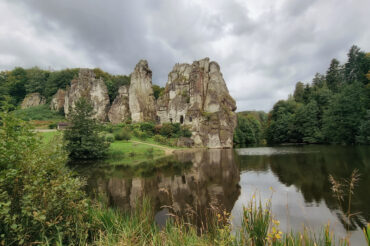
The Externsteine in the Teutoburg Forest have exerted a magical attraction on people for thousands of years. Accordingly, many legends and myths have grown up around the rock formation. It has long been assumed that a Germanic place of worship, power or assembly was located there, but this has not been proven.
A relief of the Descent from the Cross is carved into the lower section of one of the imposing stones. The rather large relief dates from the Middle Ages, probably from the 11th or 12th century. It shows Jesus being taken down from the cross. A bent tree can be seen on it, which some identify as the Irminsul. This depiction is interpreted as the victory of Christianity over paganism, as the sacred symbol of the Germanic tribes has been bent over.
The National Socialists carried out extensive archaeological excavations in the area of the Externsteine in order to prove the existence of a Germanic cult site. However, they did not succeed.

Spectacular: Velmerstot near Horn-Bad Meinberg
There are two mountains called Velmerstot, which are only a few minutes’ walk apart. However, the Prussian Velmerstot is a few metres higher than the Lippe Velmerstot. The Irmin Column is said to have once stood on the highest mountain in the Teutoburg Forest. Today there is an observation tower. But these are just legends. The two Velmerstots have been regarded as places of power and gathering for centuries, if not millennia. For me, the Lippische Velmerstot is more impressive because the mighty stone formation on its top is unique.

Legendary: Desenberg Castle near Warburg
Desenberg Castle is one of the most legendary places in East Westphalia. A multitude of legends surround the castle ruins and the pointed mountain of Daseberg. A terrible dragon is said to have once lived at the foot of the mountain and Charlemagne is said to rest in the Desenberg, only to rise again at some point. The Desenberg may once have been a place of worship for Germanic tribes. Due to its prominent location – the Desenberg is a former volcano – and its strategic importance, this place is also associated with the Irminsul.
There is evidence that people settled around the Desenberg as early as the Middle Ages. A circular ring ditsch was discovered during archaeological excavations in 1995. On the day of the solstice, it was possible to observe the sun setting directly behind the mountain cone in the centre of the circle. Pottery shards and the remains of burnt animal skeletons were found in two holes. However, the circular ditch is probably much older than the Irminsul and is thought to have been built 4600 years before Christ. Later, in the early Middle Ages, the Germanic tribes lived there. It can be assumed that the site was colonised by humans and used as a place of worship for centuries.
Find out more about the Daseburg and the legends of the place in my article: Desenburg near Warburg

Powerful: Iburg near Bad Driburg
Only a few walls of the Iburg remain as ruins. And yet the Iburg is one of my favourite places in East Westphalia – perhaps it is even my place of power. At the very least, it’s my favourite place to collect wild garlic in fabulous surroundings.
The Iburg is also one of the Saxon castles that played an important role in the course of Christianisation. It was probably built in the 7th or 8th century as a Saxon rampart castle. Although the castle complex was mainly made of wood, some limestone walls from this period have been preserved, which presumably served as foundations. Charlemagne destroyed the castle complex in the course of Christianisation and built a church in its place. The foundation walls of this ancient St Peter’s Church or chapel are still preserved. Charlemagne destroyed the Iburg in 772. He is also said to have destroyed the Irminsul in the same year. It is therefore assumed that the Irminsul could have been located on the grounds of the Iburg or in its vicinity.
I have also published an article about the Iburg: Mysterious Iburg ruins near Bad Driburg

Idyllic: Tönsberg near Oerlinghausen
Like the Iburg castle hill, the Desenberg or the Velmerstot, the Tönsberg is a striking elevation that can be seen from afar. There was once a Saxon castle on the Tönsberg , which was destroyed during Christianisation. The ramparts of the castle are still recognisable today. Tönsberg is also said to have been a place of worship or power.
The ruins of St Anthony’s Chapel can still be admired on the Tönsberg today. However, this was only built in the 15th century. There is no documentary mention of the Irminsul in connection with the Tönsberg. The theory that the Irminsul is said to have stood on the Tönsberg dates back to the 1930s.
Tönsberg is a wonderful place to hike, so here is a hiking recommendation to the chapel ruins: Hiking in the Teutoburg Forest around the Tönsberg

Mythical: Drudenhöhle and Karlsschanze in the Eggegebirge mountains
Not far from Willebadessen, on the Teutonia cliffs in the middle of the forest, there is a mystical cave. The Durdenhöhe is named after the Drudes from Germanic mythology. They were wise women, goddesses of fate or witches – depending on the interpretation. This makes me think of the three witches or prophetesses from Shakespeare’s “Macbeth”. Three of these Druid women are said to rest in the Drudenhöhle.
Just a few metres from the Drudenhöhle is the Karlsschanze, another former Saxon castle complex, of which only a few ramparts remain today. The Irminsul is also thought to have been located here, but this also appears to be a more recent theory.
But I was even more fascinated by another legend about the Drudenhöhle. Perhaps you have heard of the blue flower, the object of longing of the Romantics? The best known is probably the description in the novel “Heinrich von Ofterdingen” by Novalis. It is said that the blue flower blooms every 100 years in the Drudenhöhle near Willebadessen.
The area around the Drudenhöhle and the Karlsschanze is perfect for hiking. You can find my hiking recommendation here: Hike to the mystical sites in the Eggegebirge.

Lower Saxon: Village of Irmenseul near Hildesheim
While all the potential Irminsul sites mentioned so far are within a radius of 50 to 60 kilometres, we are now moving slightly further east. Not far from Hildesheim, in the municipality of Lamspringe, is the village of Irmenseul. The very name of the village could be a reference to the Irmen column. Was the Irminsul located in Lower Saxony? There are only legends about this today. Some tell of the rescue of the Irminsul. To protect the shrine from Charlemagne’s troops, the Saxons are said to have fled eastwards with the column and hidden it where the village of Irmenseul is located today. Later, the Irminsul is said to have been kept in Hildesheim Cathedral. To this day, there is a column in the choir of Hildesheim Cathedral that is called the Irmin Column. However, it is made of stone. Embedding the largest Germanic shrine in a Christian building could have been more effective than destroying it.
Where was the site of Irminsul? The great secret
The Germanic tribes hardly had any writing. It is known that they used runes from the 2nd century onwards, for example to label weapons. However, they did not have written documents, annals, reports or even books. They passed on their history and stories orally. This knowledge has been lost; there are only the reports of the Franks, which do not speak favourably of the Germanic tribes. The castles and settlements from this period have also been lost. They were built of wood. Knowledge about the life, culture and religion of the Germanic tribes is therefore very patchy. These gaps are filled by the imagination and the many sagas and legends. But this is precisely what makes East Westphalia so special! There are few regions in Germany that are the subject of so many legends. Many of the places mentioned in today’s article are well worth a visit and perfect for an excursion. If you have several days to spare, all the better, as most of the potential Irminsul locations are not far from each other.
Locations of the Irminsul on the map
You are currently viewing a placeholder content from Default. To access the actual content, click the button below. Please note that doing so will share data with third-party providers.
More InformationSources on the locations of the Irminsul
Wikipedia: Irminsul
Ingo Stock: Magical places in the Eggegebirge: Between Marsberg, Paderborn, Detmold and Warburg*(Affiliate link to amazon.de)
* The links labelled as such are affiliate links. This means that if you order something through this link, no matter what, I get a small commission.

Leave a Reply