


Would you like to travel back in time just outside Cluj-Napoca? Then I recommend a day trip from Cluj-Napoca to the castles of the Bánffy family. The two castles in Bontida and Râșcruci are among the best excursion destinations in the region – regardless of whether you are interested in magnificent architecture or aristocratic history. Both castles are now museums and open to visitors. Thanks to the easy accessibility by bus and train, you can visit both castles as a day trip from Cluj, without the need for a car.

One of the most important noble families in Hungary – the Bánffy family
The origins of the Bánffy family date back to the 13th century. There are two branches of the family. One, the Bánffy family of Losoncz, was very influential in southern Hungary and Transylvania. Many important politicians, diplomats and military officers came from this family. Count Miklós Bánffy (1873-1950), who is best known for his books in the “Transylvania Trilogy“*, is one of the most famous personalities. The family history is said to be as exciting as Downton Abbey – only with far more scandals and affairs. The Bánffy family of Alsólendva, on the other hand, was based more in the south-west of the former Kingdom of Hungary, which is now part of Slovenia and Croatia.
Bánffy Castle in Bontida – the Romanian Versailles
Although a comparison with Versailles is very optimistic, Bánffy Castle in Bontida is one of the largest castle complexes in Romania. This alone makes it worth a day trip from Cluj-Napoca. It must have once been incredibly magnificent, but today you need a little imagination to imagine its former splendour. However, the complex is well worth seeing, spacious and architecturally very varied. Its decay also tells the story of the country. Incidentally, the castle is said to have once housed one of the largest private libraries.


History of Bánffy Castle
The first documented mention of a manor owned by the Bánffy family dates back to the 14th century. However, it is not known whether it was already a castle at that time. In 1387, Emperor Sigismund of Luxembourg granted the estate to the Bánffy family. Construction of the castle began in the 16th century. In the 18th century, Dénes Bánffy had the castle converted into an incredibly magnificent palace. Even then it was referred to as the “Versailles of Transylvania”. In the 19th century, further buildings were added in the neo-Gothic style. Today, these parts of the castle are among the most beautiful buildings in the complex.
Bánffy Castle during World War II
The last owner of the castle was Miklós Bánffy, a writer and former Hungarian foreign minister. During the Second World War, the Kingdom of Hungary supported the German Reich. One wing of the castle was made available to the Wehrmacht as a military hospital and warehouse.
However, in 1944, Count Miklós Bánffy turned against the German Reich and sided with the Allies. In revenge, the Wehrmacht set fire to his castle, destroying the library and most of the furnishings. However, the Wehrmacht had already stolen many valuable objects and books beforehand. Tragically, the retreating troops were bombed and the booty was also destroyed.
The castle after 1945
During communism, the castle was nationalised. It served as an agricultural production co-operative, a hospital and unfortunately also as a quarry for the surrounding villages. The castle buildings increasingly fell into disrepair. It was not until 1990 that the Transylvanian Trust began restoring the castle. The patron is King Charles III, then Prince of Wales.
Opening hours Bánffy Castle in Bontida: daily 10.00 to 18.00
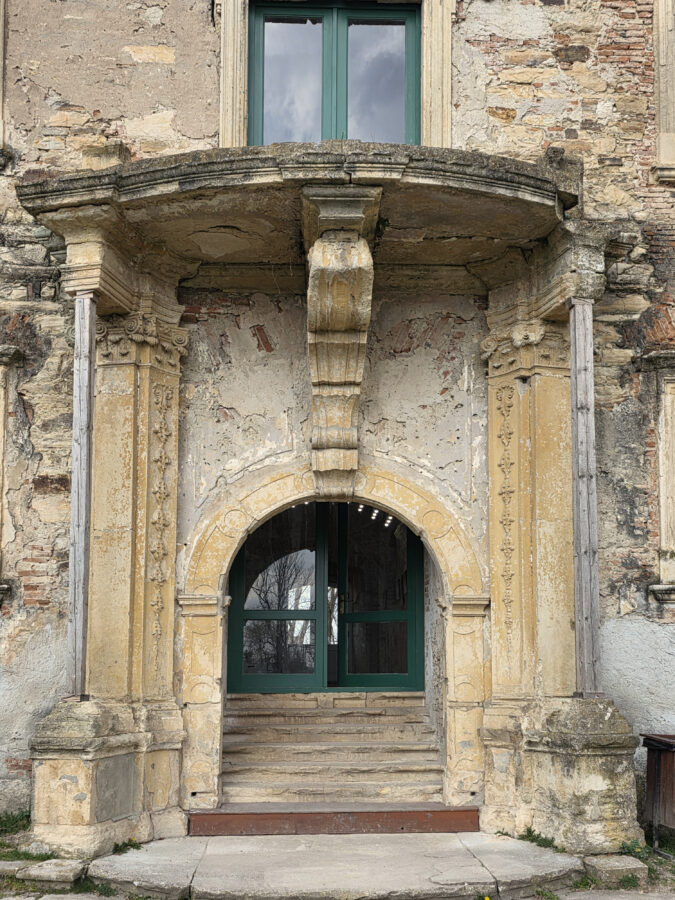
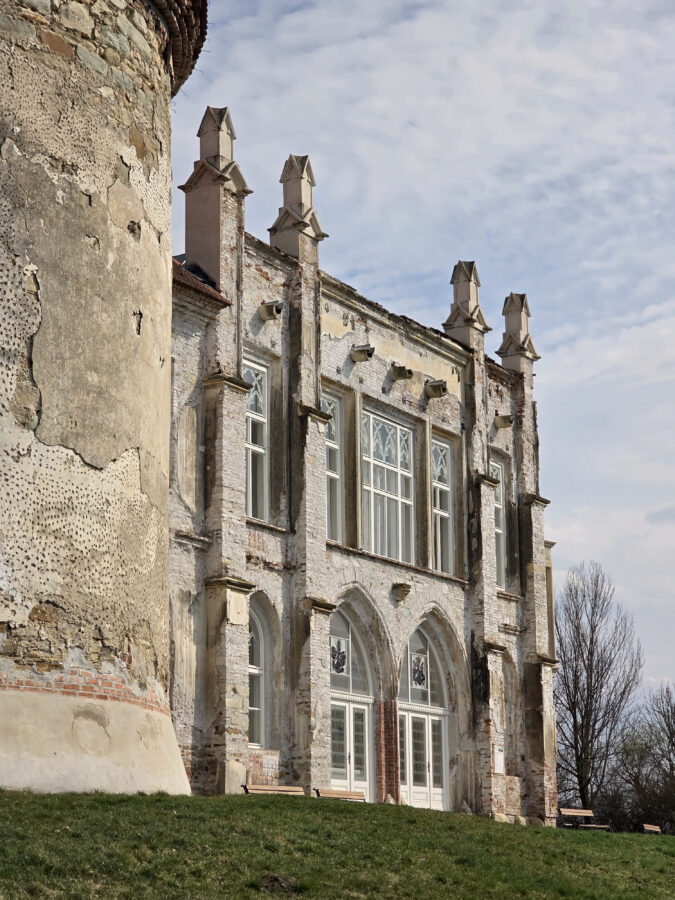
Famous residents – Maria Theresa’s cavalry captain
We have Count Dénes Bánffy to thank for transforming the castle into a magnificent Baroque complex. The castle has been known as the “Versailles of Transylvania” ever since it was rebuilt in the 18th century. Count Dénes spent several years at the Viennese court of Empress Maria Theresa. He was probably inspired by the splendour of other European castles there, because after his return he built this incredibly magnificent palace. His son, György Bánffy, built the Bánffy City Palace in Cluj.
Bánffy Castle in Bontida – venue of the Electric Castle Festival
The Electric Castle Festival is indeed world-famous, as many well-known artists perform there every year. The extensive grounds next to the castle are perfect for this. When I was in Romania at the end of March, they were already setting up for the festival, which takes place in July. The festival is huge. It has been taking place since 2013 and now attracts more than 200,000 visitors every year. There are several stages and plenty of space for camping. Over the years, very famous bands have performed there, for example The Prodigy*, Fatboy Slim*, Iggy Pop* and Florence + the Machine*. This year, The Cure* and Twenty One Pilots* are the main acts, last year it was Queens of the Stone Age* and Justin Timberlake*. As you can see, the programme offers something for everyone.
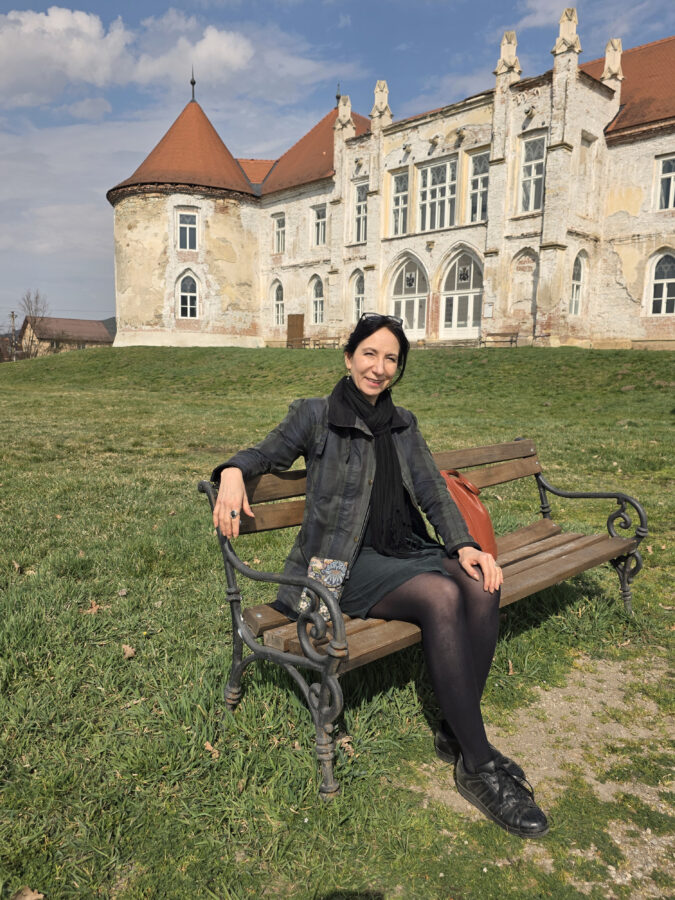

Bánffy Castle in Râscruci – the summer palace of the Bánffy family
The Bánffy family’s second castle is a palace. While the family’s old castle still needs some love and attention, the new one has been perfectly restored. It is a gem in a tiny, forgotten village.
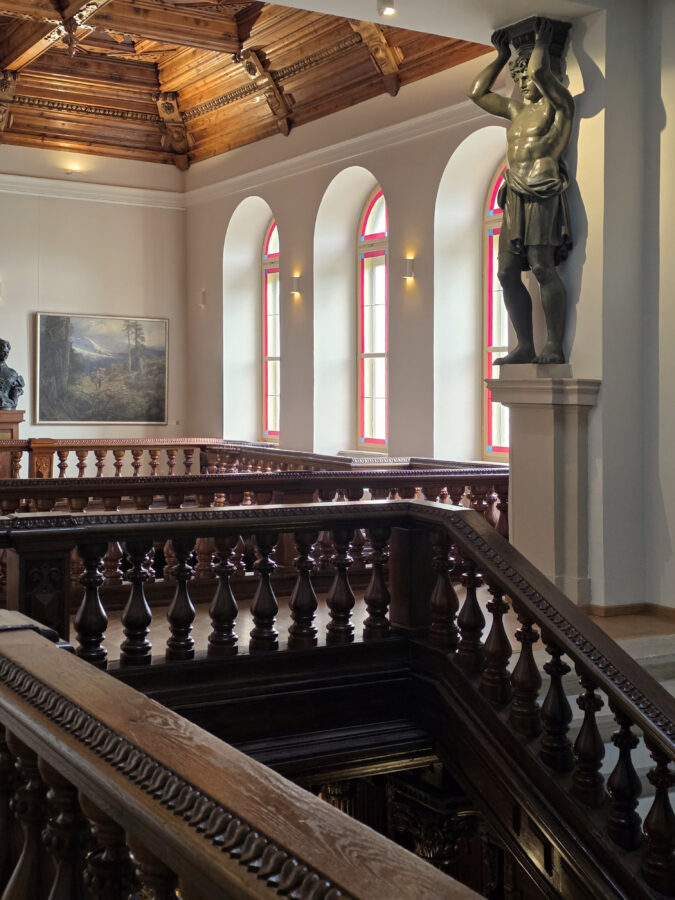
The village of Râscruci has been owned by the Bánffy family since the 14th century. However, the first documented mention of a noble residence in the village dates back to the middle of the 18th century. The current castle was built in 1809 in a mixture of Baroque and Classicist styles. It displays the symmetry and colours of the late Baroque castles, but the simplicity betrays the change in fashion. The palace was initially used as a summer residence and later as a main residence. The castle is already very impressive from the outside, but when you enter, you are even more amazed. The entrance hall and other rooms are decorated with ornate, intricate wood carvings.

History of Bánffy Castle
The first castle in Râscruci was built in the middle of the 18th century, but little remains of it today. The current castle was built by Baron György Bánffy around 1809. During the revolution of 1848/49, the castle was severely damaged, but Baron Albert Bánffy had it rebuilt. He and his wife Ágnes Esterházy chose the palace as their main residence.
The crazy works of Count Bánffy
The wooden panelling on the walls and ceilings in the German Renaissance style is said to have been carved by Baron Ádám Bánffy himself. He designed and even made them himself. Instead of pursuing a political or diplomatic career, Ádám Bánffy opted for art. During his numerous trips abroad, he not only gained inspiration, but also learnt a great deal about art and craftsmanship. He is said to have been a perfectionist who believed that no craftsman could do his work better. He is said to have spent years carving. It is not only today that this seems strange: even in the 19th century, Ádám Bánffy’s carved interiors were among the most important curiosities in the region.

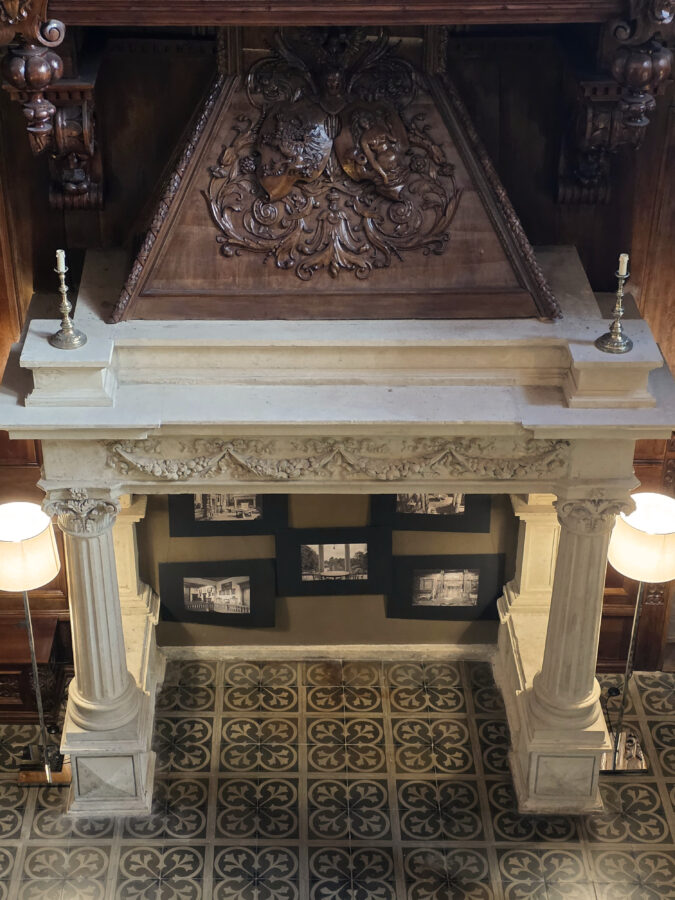
Green terracotta oven for Emperor Franz-Josef
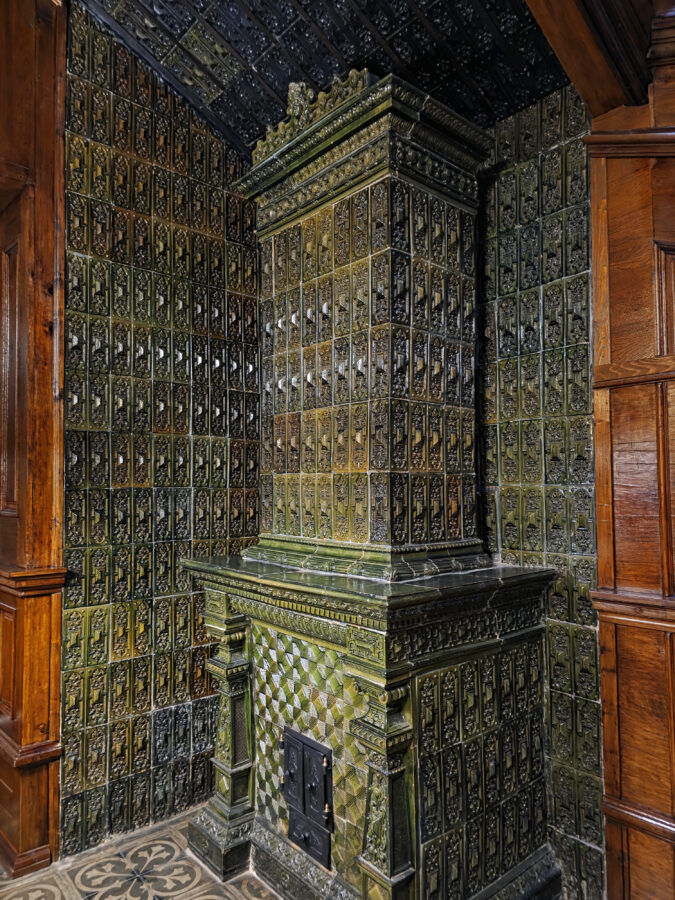
The beautiful green terracotta stove in the entrance hall is also the work of Ádám Bánffy. He is said to have made every tile himself. Bánffy presented the stove during an Austro-Hungarian national exhibition. Emperor Franz Josef was very impressed by the ornate stove, which is why Bánffy gave it to him as a gift. He made a second stove of the same design for his palace.
Bánffy Castle after nationalisation
After the end of the Second World War, the castle was owned by Albert Bánffy II, Ádám’s son, but he died in 1945. The castle was inherited by his son Dénes, who was expropriated shortly afterwards. He was able to live with his family in Bánffy Castle in Cluj for a few years, but in 1949 he was finally dispossessed. The castle was devastated during the Second World War and the library burnt down. After the war, the castle served as a school building until it was restored in 2017. Today, the castle houses a museum with an art exhibition and is used as an event location.
Opening hours Bánffy Castle in Râscruci: Tuesday – Friday 11.00 to 17.00, Saturday and Sunday in the summer months 11.00 to 19.00, in the winter months 10.00 to 18.00
Excursions by bus and train from Cluj-Napoca
Travelling by public transport in Romania is generally possible, but adventurous. I had the feeling that the times given are rather recommendations, because the buses sometimes arrive earlier, sometimes later than planned. If they arrive earlier, they don’t wait. None of the trains we used were on time. However, all German train travellers are very familiar with this by now. We always arrived where we wanted to arrive and had a very successful day trip from Cluj-Napoca.
The stops are adventurous, at least in the area around Cluj-Napoca. When travelling by train, there is a difference between a stop and a station. Only stops have a station building. At a stop, the train often stops in a field outside the town. Even with official stops, you sometimes have to walk through a field to get to the station. The big advantage, however, is that many people in the area around Cluj-Napoca speak very good English, whether it’s conductors on the train, ticket sellers at the station or other travellers you want to ask for directions. Cluj is an old and important university city, which is why knowledge of English is necessary for many people.
Accessibility of the Bánffy castles by train
As both castles are close to each other, we visited them by train. We got on at Cluj-Napoca Central Station and travelled to the castle in Râscruci first. A train journey takes about 30 minutes. The IRC25, R and TFC R trains run from Cluj in a north-easterly direction. However, as the route is operated by two different train companies, you need a suitable ticket. There are two different ticket machines and two different ticket counters. The easiest way is to buy tickets on the train. It is always possible to buy tickets from the conductor. Card payment is also possible. Public transport in Romania is very cheap.
In Râșcruci, the train stops at the edge of the village in the field. It takes about 15 minutes to walk through the village to the castle. As far as I know, there are no buses or taxis. There is nothing in Râscruci itself apart from the huge and imposing castle.
There are about 3 kilometres between Râscruci and Bontida, which we walked. There are supposed to be taxis there in summer, but none in spring. The path leads through fields, walking is no problem. Apart from a horse-drawn carriage, there was no traffic. However, the path through the fields is very monotonous and the 40 minutes dragged on.
For the return journey from Bànffy Castle in Bontida, we chose the railway station in Bontida as our train stop. It takes about 40 to 45 minutes to walk from the castle to the station, albeit through the village. Bontida is a street village consisting of one long street with houses lined up next to each other. There were two village shops and a pub.
It was a perfect day trip from Cluj-Napoca. We set off at 11am, visited two castles, had a picnic, ate ice cream and were back in Cluj by 4.30pm.

The perfectly restored Bánffy Castle in Râscruci is magnificent and worth seeing today.
And a legend at the end….
There are usually many legends about old walls, and Romanian castles and palaces are said to be inhabited by ghosts much more often than German ones. Bánffy Castle in Bontida is one of the most haunted places in Romania. As in so many castles and palaces, it is said that you can sometimes encounter a “white lady” there. Visitors have been reporting this for centuries. During the siege and destruction of the castle in 1945, the White Lady was seen particularly frequently. It is said that a young woman was once walled into the castle walls. Whether it was an unfortunate noblewoman or a disgraced maid is no longer known.
Another legend tells of the ghost of a groom who is seen around the stables. He is said to have discovered that the lady of the castle was having an affair. To silence him, she killed him.
It was long considered a legend that there were secret underground passages between the castle in Bontida and the castle in Râscruci . However, extensive underground passages were actually discovered during renovation work on both castles. Whether they connect the two castles has not yet been investigated.

Sources for today’s article
Bánffy Castle, Bontida – History
Castles of Transylvania – Bánffy Castle
Transylvania Trust
Bontida Bánffy Castle – Wikipedia
Ghost Hunters International – YouTube
* Affiliate link to amazon.de, which means that if you order something through this link, no matter what, I get a small commission.

Leave a Reply